
What Causes Student Visa Rejection? A Complete Guide for Pakistani Students
Studying abroad is an important goal for many Pakistani students, but getting admission to a university does not automatically guarantee a student visa. A visa application is assessed separately, and immigration authorities may look at finances, documents, study plans, immigration history, and whether the applicant meets the requirements of the destination country. Understanding common reasons for student visa refusal can help students prepare their applications carefully and avoid preventable mistakes.
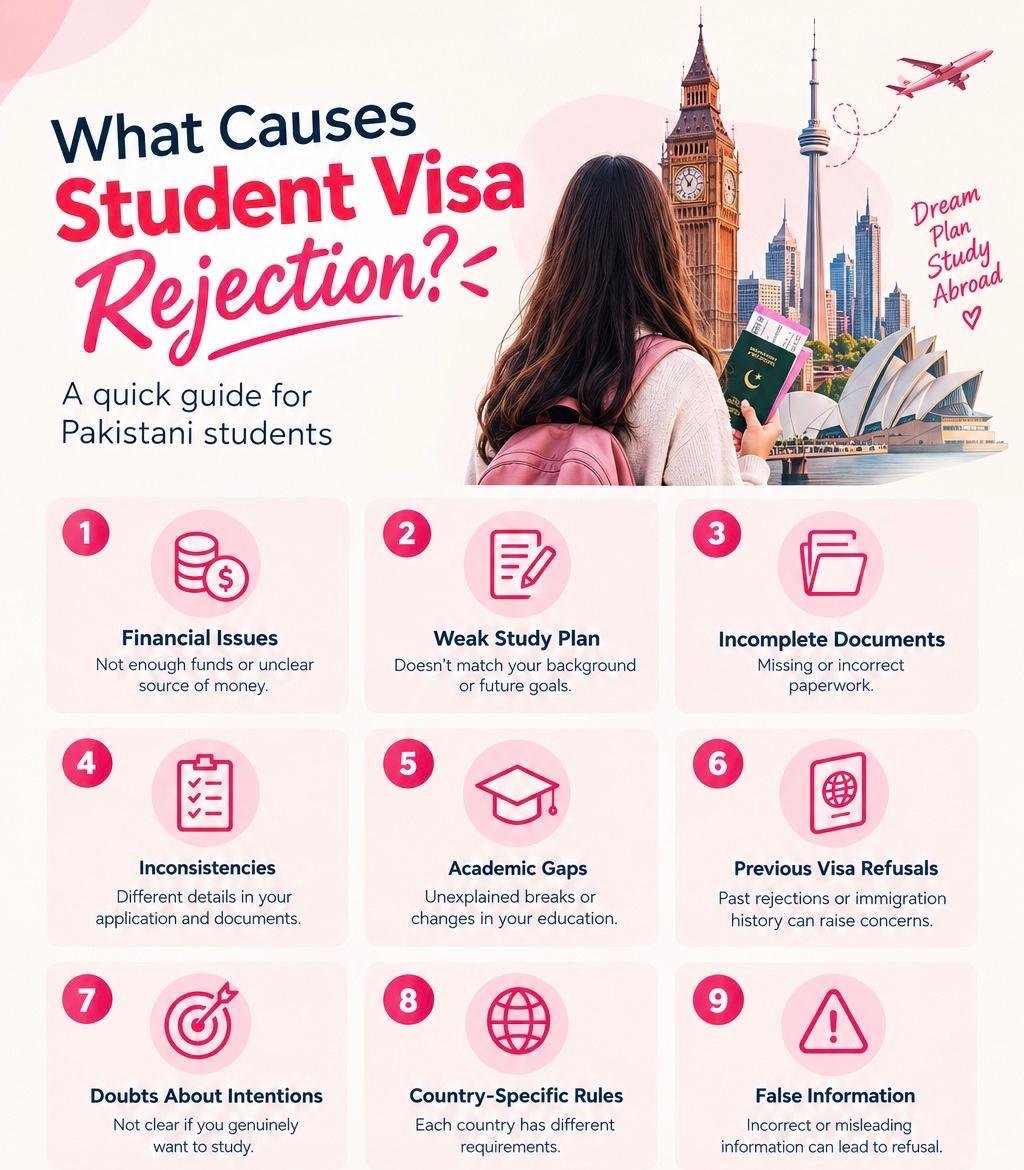
1. Insufficient Financial Evidence One of the most important parts of a student visa application is proving that you can afford your education and living expenses. For example, the UK requires eligible applicants to demonstrate funds for course fees and living costs, with specific financial evidence requirements. Canada also requires applicants to demonstrate sufficient funds for tuition, living expenses and transportation. Problems can arise when:
- The required funds are not available.
- Bank evidence does not meet the country’s requirements.
- The source of funds is unclear.
- Financial information is inconsistent with other documents.
- Required financial evidence is missing or outdated.
Students should always check the latest financial requirements for their specific country and visa category before submitting an application.
2. Weak or Unclear Study Plan A student visa application should clearly explain the applicant’s academic plans. The chosen course should make sense in relation to the student’s previous education, experience and future plans. If the application does not clearly establish why the student selected a particular course or institution, this can create concerns. Australia’s Genuine Student assessment, for example, considers why an applicant wants to study the particular course with the chosen education provider and how the course will benefit the applicant’s future. A strong study plan should therefore be:
- Clear
- Consistent
- Relevant to the applicant’s background
- Supported by genuine evidence
- Focused on the proposed education
3. Incomplete or Incorrect Documents Missing documents or incorrect information can create serious problems. Depending on the country and individual circumstances, applicants may need documents such as:
- Valid passport
- University admission documents
- Financial evidence
- Academic certificates and transcripts
- English-language evidence, where required
- Medical or tuberculosis documents, where applicable
- Sponsorship or loan evidence, where applicable For example, UK Student visa applicants must provide a passport and CAS, and may need financial evidence and other documents depending on their circumstances.
Australia also advises applicants to check the document checklist carefully and warns that required evidence may be necessary before submission.
4. Inconsistencies in the Application Consistency matters throughout a visa application. Information in your application should be consistent with your supporting documents. Differences in details such as education history, employment, finances, travel history or personal information can lead to additional questions or concerns.
Before submitting, students should carefully check:
Application form → Academic documents → Financial documents → University documents → Personal information
Everything should accurately reflect the applicant’s circumstances.
5. Unexplained Academic History Students may have study gaps, changes of field, repeated courses or periods without formal education. These circumstances do not automatically mean a visa will be refused. However, applicants should be prepared to explain their academic history accurately and provide supporting evidence where appropriate. The important point is to avoid leaving significant parts of an educational or employment history unexplained when the visa application requires that information.
6. Previous Visa Refusals or Immigration History Previous visa applications and immigration history can also be relevant. Australia’s Genuine Student assessment specifically considers immigration history, including previous visa applications, refusals and cancellations. Students should therefore provide accurate information about previous applications rather than attempting to hide a previous refusal.
7. Doubts About the Main Purpose of Study A student visa is intended primarily for education. Immigration authorities may assess whether the applicant genuinely intends to study and comply with the conditions of the visa. Canada’s official guidance, for example, says an application may be refused if the officer is not convinced that the applicant’s main purpose in Canada is to study or that they will leave Canada at the end of the authorized study period. This is why students should understand their:
- Course
- University or college
- Study location
- Course duration
- Academic progression
- Future plans
8. Failure to Meet Country-Specific Requirements Every country has its own student visa rules. For example, the UK has specific requirements concerning financial evidence and CAS documents. Australia has a Genuine Student requirement and may require evidence relating to financial capacity and English-language ability. Canada has its own study-permit requirements concerning admission, finances and other eligibility factors. Therefore, students should not rely on a general checklist found online. Requirements should be checked against the official immigration guidance for the country and visa category.
9. False or Misleading Information Providing inaccurate information or misleading evidence can have serious consequences. Students should never alter documents, provide false financial information or hide relevant immigration history simply to strengthen an application. A genuine application supported by accurate documents is essential. How Can Students Reduce the Risk of Visa Refusal? Before submitting your student visa application, create a checklist and review every part of your application.
→ Visa Application Checklist
→ Check the latest visa requirements
→ Confirm your university documents
→ Review your financial evidence
→ Make sure your information is accurate
→ Explain your academic progression clearly
→ Prepare required English-language evidence
→ Check your immigration history
→ Review every document before submission
→ Keep information consistent across the application
→ Use official immigration guidance for the final requirements