
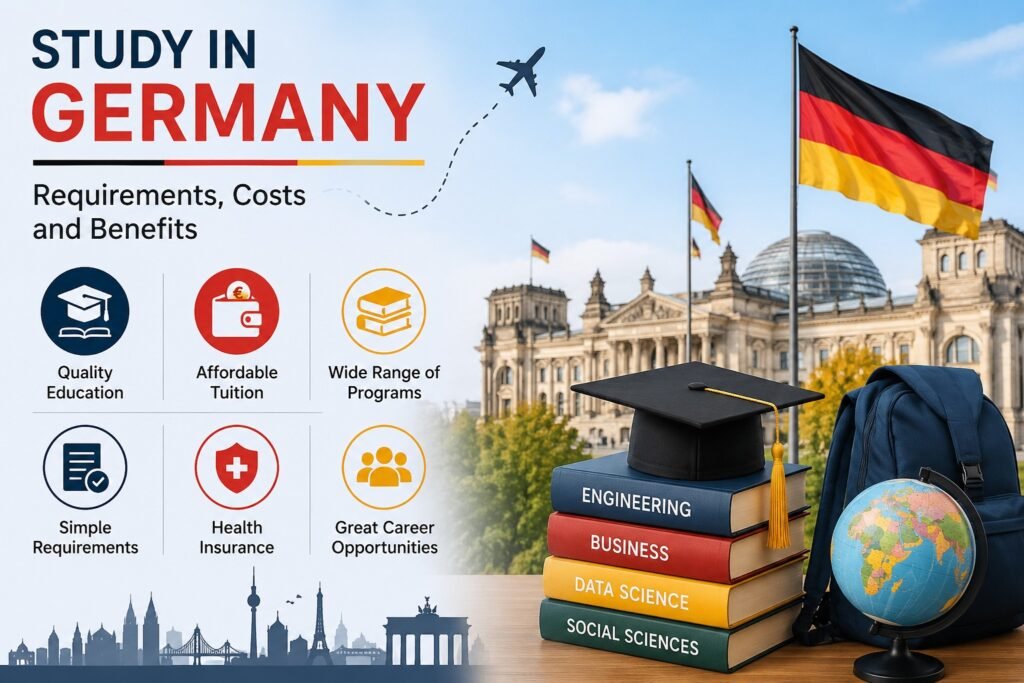
Germany has become one of the most popular study destinations for international students. Students from Pakistan and other countries choose Germany because of its strong education system, internationally recognised universities, modern facilities, and wide range of academic programmes. Germany is especially attractive for students who want quality education while managing their overall study budget carefully.
For Pakistani students, studying in Germany can be a great opportunity to experience a different education system, develop international skills, and prepare for future career opportunities. However, the process requires proper planning. Students need to understand admission requirements, language requirements, tuition fees, living costs, financial proof, visa requirements, and university application procedures before starting their journey.
The first step is to choose the right programme. Germany offers programmes in many fields, including computer science, engineering, business, artificial intelligence, data science, information technology, healthcare, finance, management, and social sciences. Students should select a programme according to their previous education, academic background, interests, and future career plans.
Before applying, students should check whether their previous qualification meets the admission requirements of the selected university. Requirements can vary depending on the university, degree level, and programme. Students may need to provide educational certificates, academic transcripts, a valid passport, proof of language proficiency, a CV, a motivation letter or other documents requested by the university.
Academic requirements are particularly important for Pakistani students. Students applying for a Bachelor’s degree normally need an appropriate higher secondary qualification and may have to meet additional requirements depending on their educational background. Students applying for a Master’s degree generally need a relevant Bachelor’s degree from a recognised institution. The previous degree should normally be related to the selected Master’s programme.
Some students may need additional academic preparation before they can enter a German university. This can depend on their previous qualification and the university’s assessment of their academic background. Therefore, students should check the admission rules of each university instead of assuming that the same requirements apply everywhere.
Language is another important part of the application process. Germany offers both German-taught and English-taught programmes. Students applying for English-taught programmes may need to provide an accepted English language test, depending on the university and programme. Commonly requested tests can include IELTS or other recognised English language qualifications.
Students applying for German-taught programmes may need to demonstrate German language proficiency. The required level depends on the course and university. Some programmes may require a higher level of German because students need to understand lectures, assignments, examinations, and academic materials in German.
One of the major reasons students consider Germany is its public university system. Many public universities offer programmes with no traditional tuition fee, particularly for certain Bachelor’s and Master’s programmes. However, students should understand that studying in Germany is not completely free. Universities normally charge a semester contribution, and students still need to pay for accommodation, food, transportation, insurance, study materials, and other personal expenses.
Tuition fees can also vary according to the university, programme, and state. Some public universities or programmes may charge tuition fees for certain international students, while private universities generally have higher tuition costs. Because fees and regulations can change, students should always check the current information provided by their chosen university.
Living expenses are another major part of the study abroad budget. Students need to plan for rent, groceries, transportation, health insurance, study materials, mobile services, and personal expenses. The cost of living can be higher in large cities such as Munich, Frankfurt, Berlin, and Hamburg, while smaller cities may offer more affordable accommodation options.
Accommodation is usually one of the biggest monthly expenses for international students. Students may choose university accommodation, shared apartments, private rooms, or other housing options. Availability can be limited in popular student cities, so students should start looking for accommodation as early as possible.
Students also need to consider health insurance. Health insurance is an important requirement for international students in Germany, and students generally need suitable coverage for their visa and enrolment process. The exact insurance arrangements can depend on the student’s circumstances and university.
Financial planning is an essential part of the German student visa process. International students generally need to demonstrate that they have enough money to cover their living expenses in Germany. One commonly used option is a blocked account, although other accepted forms of financial proof may be available depending on the student’s situation and current visa rules.
The required financial amount can change over time, so students should check the latest official requirements before transferring money or preparing their visa application. Proper financial planning can help students avoid delays and document-related problems.
The student visa process is another important stage. After receiving admission or meeting the relevant university requirements, students need to prepare their visa application according to the applicable German rules. Documents may include a valid passport, admission letter, proof of financial resources, health insurance, academic documents, language proof, and other supporting documents.
Students should carefully check the current requirements before submitting their application. Missing documents, incorrect information, or incomplete financial evidence can create unnecessary delays. Preparing documents in advance gives students more time to correct any problems before their visa appointment or application submission.
Germany also provides students with opportunities to gain practical experience during their studies, subject to the applicable rules. International students may be allowed to work within certain legal limits. This can help students gain professional experience and manage some of their everyday expenses. However, students should not depend entirely on part-time work to finance their education and living costs.
Another advantage of studying in Germany is the country’s strong connection between education, research, and industry. Students in fields such as engineering, technology, computer science, business, and applied sciences can benefit from an environment that values innovation and practical knowledge.
Germany is also home to many internationally recognised universities and research institutions. Students can find programmes that combine theoretical learning with practical skills. Depending on the programme, students may have access to laboratories, research projects, internships, industry-related activities, and other academic opportunities.
For Pakistani students, the international environment can also be an important benefit. German universities welcome students from different countries, creating multicultural classrooms where students can interact with people from different backgrounds. This can help students improve communication skills, develop international networks, and gain a broader understanding of different cultures.
Germany can also be a good option for students interested in technology and engineering. The country has a strong reputation in areas such as automotive engineering, mechanical engineering, electrical engineering, computer science, manufacturing, and research. Students interested in emerging fields such as artificial intelligence, cybersecurity, data science, and software development can also find relevant programmes.
Choosing the right university and programme is very important. Students should not select a university only because it has low tuition fees. They should also consider the course structure, entry requirements, language of instruction, location, living costs, university reputation, career opportunities, and their own academic profile.
This is where professional education consultancy can make the process easier. PEN Consultants can support Pakistani students throughout their study abroad journey. The process can begin with profile evaluation, where students’ academic background, qualifications, interests, and future plans are reviewed.
PEN Consultants can also assist students with course selection and university shortlisting. Instead of applying randomly, students can explore programmes that are more suitable for their academic background and future goals. Proper university selection can help students save time and reduce the risk of applying to programmes that do not match their qualifications.
Application guidance is another important service. Students may need help understanding university requirements, preparing documents, completing applications, and meeting deadlines. PEN Consultants can guide students through these stages and help them stay organised during the application process.
SOP and motivation letter preparation can also be an important part of the application. A well-prepared document should clearly explain the student’s academic background, reasons for choosing the programme, interest in the subject, and future plans. PEN Consultants can guide students in preparing professional and relevant application documents.
Visa documentation is another area where students need careful preparation. PEN Consultants can provide guidance regarding financial documents, supporting paperwork, application preparation, and interview preparation. Students can also receive guidance about what to expect before travelling to Germany.
The overall process of studying in Germany requires patience and careful preparation. Students should begin by researching suitable programmes, checking eligibility, preparing their documents, understanding financial requirements, and keeping track of application deadlines. Starting early gives students more time to solve unexpected problems.
Germany offers many advantages for international students, including quality education, internationally recognised qualifications, a wide range of programmes, research opportunities, and affordable options at many public universities. At the same time, students should understand that studying abroad involves costs and responsibilities. Tuition policies, living expenses, visa requirements, and financial rules should always be checked using current official information.
For Pakistani students who want to study in Germany, the right preparation can make the journey more organised and manageable. With professional guidance from PEN Consultants, students can receive support from the initial profile evaluation through university selection, application preparation, documentation, and visa guidance.
If Germany is part of your study abroad plan, start preparing early, choose your programme carefully, understand the costs, and make sure your documents meet the requirements. With proper planning and the right guidance, studying in Germany can become a valuable step toward achieving your academic and professional goals.