
Study in the UK with 50%–60% Marks: Available Options

Introduction
Do you want to study in the UK but have only 50%–60% marks? You may still have options. Many Pakistani students worry that average academic results will prevent them from pursuing higher education in the United Kingdom. However, admission requirements vary depending on your previous qualification, chosen course, university, and academic level.
Some UK universities offer foundation programmes or pre-master’s pathways for students who do not meet the requirements for direct entry. Certain postgraduate programmes also consider Pakistani bachelor’s degrees with marks within this range. For example, the University of Hertfordshire lists a 50% minimum for its pre-master’s route and 55% for many taught postgraduate programmes, although course-specific requirements apply.
The important point is to choose a course that matches your academic profile instead of applying randomly to universities.
In this guide, PEN Consultants explains how Pakistani students can explore UK study options with 50%–60% marks, which pathways may be available, and what to check before applying.
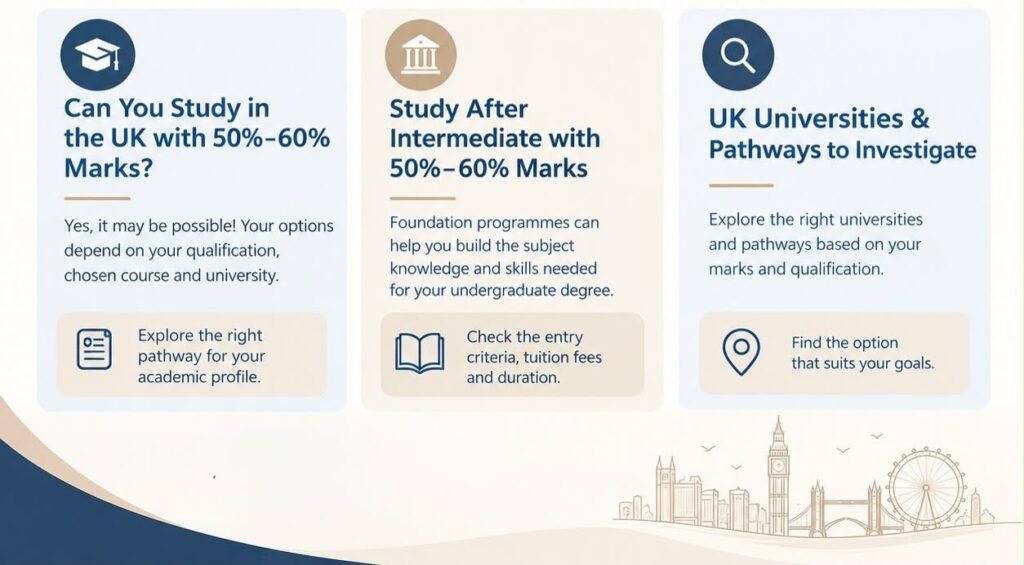
1. Can You Study in the UK with 50%–60% Marks?
Yes, it may be possible, but 50%–60% marks do not guarantee admission to a UK university. Your options depend on whether you have completed Intermediate, a bachelor’s degree, or a master’s degree. Universities assess qualifications differently. A percentage that meets the requirement for one programme may be insufficient for another.
- 55%–60% in Intermediate: Some foundation or undergraduate pathway options may be available, while direct bachelor’s entry depends on the university’s Pakistan-specific criteria.
- 50%–55% in a bachelor’s degree: Selected pre-master’s or postgraduate pathway programmes may be worth investigating.
- 55%–60% in a bachelor’s degree: Some universities may consider applicants for certain master’s programmes, depending on the degree structure, institution, subject, and required UK degree classification.
For example, the University of Reading’s Pakistan entry requirements list postgraduate equivalencies ranging from 50% to 60%, depending on the qualification and relevant requirements.
2. Study in the UK After Intermediate with 50%–60% Marks
Pakistani students who have completed FA, FSc, ICS, ICom, or another Intermediate qualification should check whether their marks meet the entry criteria for their intended undergraduate programme.
Direct entry into the first year of a bachelor’s degree is not available under the same conditions at every UK university. Some institutions require higher Intermediate marks, specific subjects, or additional qualifications.
Foundation programmes
A foundation programme can provide an alternative route for students who do not meet the direct-entry requirements for a bachelor’s degree.
Depending on the institution, a foundation programme may help students develop subject knowledge, academic writing, research skills, and English-language proficiency before progressing to an undergraduate degree.
For example, the University of Hertfordshire lists 60% or above for its foundation route for the relevant Pakistani school qualification. University College Birmingham lists an International Foundation Diploma option for HSSC applicants with 55%–69%. These are institution-specific examples, not universal admission rules.
3. UK Universities and Pathways to Investigate with 50%–60% Marks
Rather than assuming every university accepts the same percentage, use official country-specific entry pages to identify potentially suitable routes.
University | Option to investigate | Important consideration |
University of Hertfordshire | Pre-master’s and selected postgraduate programmes | Lists 50% for pre-master’s and 55% for many taught postgraduate programmes; check the specific course. |
University of Reading | Selected postgraduate degrees | Its Pakistan guidance describes postgraduate equivalencies ranging from 50% to 60%, depending on qualifications and requirements. |
University College Birmingham | Foundation and pre-master’s routes | Lists particular pathway options for Pakistani qualifications within relevant percentage ranges. |
Robert Gordon University | Postgraduate and pathway options | Its Pakistan guidance discusses postgraduate requirements and case-by-case consideration in some circumstances. |
4. Can You Study for a Master’s in the UK with 50%–60% Marks?
Students who have completed a bachelor’s degree in Pakistan may have postgraduate options in the UK, even if their marks are between 50% and 60%.
However, universities consider more than the final percentage. They may assess:
- Whether your bachelor’s degree is two, three, or four years long.
- The university that awarded your qualification.
- Your degree subject and its relevance to the intended master’s.
- Your CGPA or overall percentage.
- Your English-language proficiency.
- Additional academic or professional requirements.
For instance, University College Birmingham publishes separate requirements for pre-master’s routes and direct MA/MSc admission. Its guidance includes certain pre-master’s options for applicants with marks between 50% and 59%, while direct postgraduate entry has different criteria.
What if your marks are below the direct-entry requirement?
You can investigate pre-master’s programmes. These courses are designed to help eligible students prepare for postgraduate study. Before choosing this route, check whether successful completion allows progression to your intended master’s degree, what grades you must achieve, and whether the total cost fits your budget.
5. Choose the Right Course for Your Academic Background
Your chosen subject can influence your admission chances. Universities may be more willing to consider an application when your previous qualification is relevant to the proposed programme and meets its academic requirements.
For example:
- A business graduate could explore suitable business management programmes.
- A computer science graduate could investigate relevant computing or information technology courses.
- An English graduate could consider eligible programmes related to English, education, or communication.
- An engineering graduate could explore relevant engineering or technology programmes.
These are examples, not guaranteed admission pathways. Some courses require higher marks, specific previous subjects, relevant experience, or professional qualifications.
Avoid choosing a course only because its entry requirement appears lower. Consider the course content, qualification recognition, career relevance, and progression opportunities before applying.
6. English-Language Requirements for UK Universities
Academic marks are only one part of your application. You may also need to demonstrate English-language proficiency. Depending on the university and course, accepted evidence may include IELTS, another approved English-language test, or an alternative qualification accepted by the institution. Check the exact requirements for your programme, including minimum scores in individual components. Do not assume that every university accepts the same test or offers the same exemptions.
For student visa information, read the official UK Student visa guidance. Your university will confirm which English-language evidence it requires for admission and, where relevant, the applicable visa process.
7. Understand UK Tuition Fees and Living Expenses
Before applying, calculate the full cost of your intended degree. Tuition fees differ by university, course, study level, and duration.
Your budget should include:
- Tuition fees and any required deposit.
- Accommodation and utility bills.
- Food and daily living expenses.
- Transportation.
- Visa and applicable health-related charges.
- English-language tests and application expenses.
- Flights and initial settlement costs.
Students must also meet the applicable financial requirements for a UK Student visa. The required amount depends on factors including where you study and your outstanding course fees. Check the latest figures on the official UK government financial requirements page. Do not rely on part-time employment to cover all your expenses. Build a realistic budget before accepting an offer.
8. Documents Pakistani Students Should Prepare
A well-organized application helps the university assess your academic background and eligibility.
Depending on the programme, you may need:
- A valid passport.
- Intermediate or bachelor’s degree certificates.
- Academic transcripts and marksheets.
- English-language test results, if required.
- A statement of purpose or personal statement.
- Academic or professional references, where requested.
- A CV for relevant programmes.
- Additional documents required by the university.
If you have a study gap, a change of subject, or lower academic marks, prepare accurate information about your background. Explain relevant circumstances honestly and provide supporting evidence where appropriate.
Never change grades or submit misleading documents. Admission decisions depend on the university’s assessment of your genuine qualifications.
9. Student Visa Requirements After Receiving an Offer
Getting a university offer is an important milestone, but it does not guarantee visa approval. For a UK Student visa, applicants generally need an offer from a licensed student sponsor, a Confirmation of Acceptance for Studies (CAS), sufficient funds, and the required English-language evidence, subject to the applicable rules. Review the official UK Student visa overview and course requirements.
Check the latest financial evidence rules, document requirements, and application procedures before submitting your visa application. A university or education consultant cannot guarantee a visa decision made by UK immigration authorities.
10. How PEN Consultants Can Help Students with 50%–60% Marks
Choosing suitable UK universities can be challenging when your academic marks are between 50% and 60%. PEN Consultants can help students from Pakistan understand their options and organize their study abroad plans.
Our guidance can include:
- Profile evaluation: Review your academic qualifications and intended study level.
- Course selection: Identify programmes relevant to your previous education and goals.
- University shortlisting: Research institutions with potentially suitable entry criteria.
- Application assistance: Organize documents required by your selected universities.
- Visa documentation guidance: Understand the relevant process and supporting evidence.
Every student’s profile is different. Available options depend on university requirements, course eligibility, finances, and other factors. Admission and visa outcomes cannot be guaranteed.
Visit PEN Consultants to learn more about study abroad guidance, or use the contact page to enquire about support.
Common Mistakes to Avoid
When applying to study in the UK with 50%–60% marks, avoid these common mistakes:
- Assuming all UK universities accept the same percentage.
- Applying for a master’s without checking degree equivalency.
- Ignoring foundation or pre-master’s progression requirements.
- Choosing a course unrelated to your academic background without checking eligibility.
- Underestimating tuition fees and living expenses.
- Ignoring English-language requirements.
- Trusting promises of guaranteed admission or visa approval.
Careful research can help you focus on suitable programmes and avoid unnecessary application costs.
Conclusion
Studying in the UK with 50%–60% marks may be possible for some Pakistani students, but the available options depend on your previous qualification, degree level, intended subject, and chosen university.
Students who have completed Intermediate may investigate foundation or other eligible pathway programmes. Bachelor’s graduates can explore selected pre-master’s and postgraduate options where their qualifications meet the university’s requirements.
The best next step is to review your academic profile, compare official entry requirements, calculate your budget, and prepare the required documents. Planning to study in the UK with 50%–60% marks? Contact PEN Consultants for guidance on exploring suitable courses and universities for your academic background.