
Complete Guide to Studying Abroad After Intermediate in Pakistan
Introduction
Attending Intermediate courses is an essential prerequisite to pursue higher studies for Pakistani students. After getting FSc, FA, ICS, or ICom, most Pakistani students opt for studying abroad for obtaining international qualifications and acquiring skills for their future career.
Nevertheless, one should plan carefully which country and university to choose for studying there because Pakistani students need to have sufficient information about admission criteria, tuition fees, accommodation costs, English language requirements, and visa formalities prior to submitting an application form.
This guide will help you find out how to apply to study abroad after Intermediate from Pakistan in 2027.
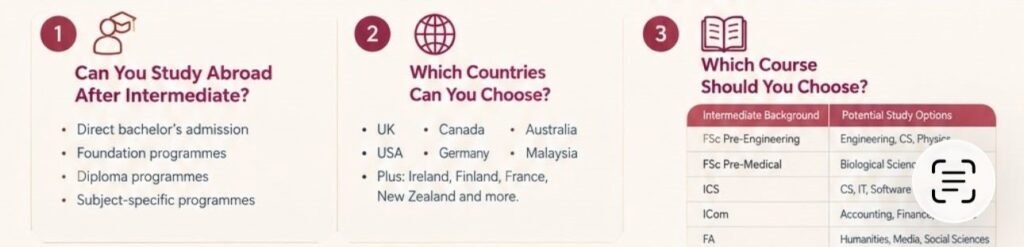
1. Can You Study Abroad After Intermediate?
Yes, you can. There are many options for Pakistani students to pursue education internationally after Intermediate. However, your eligibility depends on the country, university, programme, subjects, and academic achievements.
The main study options are:
- Bachelor’s admission directly: Some foreign universities accept Pakistani Intermediate qualifications for undergraduate studies.
- Foundation programmes: Courses of preparation for students requiring additional academic preparation prior to bachelor’s studies.
- Diploma programmes: Some universities provide certain diploma or other types of programmes.
- Specific subject-oriented programmes: Some courses require specific subjects or grades.
2. Which Countries Can You Choose?

Study in the UK
The UK offers bachelor’s degrees, foundation programmes, and a wide range of academic subjects. Entry requirements vary by institution.
Explore Study UK and PEN Consultants.

Study in Canada
Canadian universities and colleges offer different academic pathways in business, technology, science, and other fields.
Explore EduCanada.
Study in Australia
Students can investigate undergraduate degrees and eligible preparatory programmes across various disciplines.
Explore Study Australia.

Study in the USA
US institutions provide a wide range of majors, undergraduate programmes, and potential financial aid options.
Explore EducationUSA.

Study in Germany
Germany is worth exploring for engineering, science, and technology. Students must check qualification recognition and language requirements.
Explore DAAD

Study in Malaysia
Malaysia offers programmes in business, IT, engineering, and other subjects, including selected English-taught options.
Explore Education Malaysia.
Other destinations worth researching include Ireland, Finland, France, and New Zealand. Compare tuition, accommodation, course availability, and visa requirements before deciding.
3. Which Course Should You Choose?
Your Intermediate subjects can help you identify suitable degree programmes.
Intermediate background | Potential study options |
FSc Pre-Engineering | Engineering, mathematics, physics, computer science |
FSc Pre-Medical | Biological sciences, biotechnology, public health |
ICS | Computer science, IT, software engineering, data science |
ICom | Accounting, finance, business management, economics |
FA | Humanities, media, social sciences, languages, selected business programmes |
These are general examples. Universities may require specific subjects, minimum grades, entrance tests, or additional qualifications.
Choose a course that matches your interests, academic strengths, and long-term goals rather than selecting a programme only because it is popular.
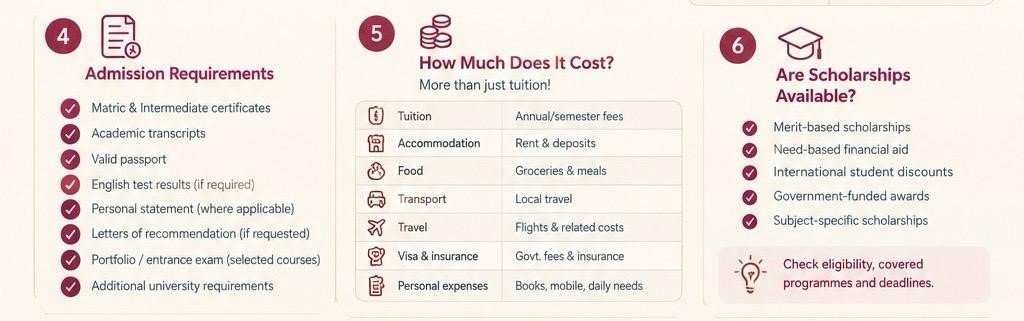
4. What Are the Admission Requirements?
Most international applications require some combination of the following:
- Matriculation and Intermediate certificates or result cards.
- Academic transcripts.
- A valid passport.
- English-language test results, if required.
- Personal statement or statement of purpose, where applicable.
- Letters of recommendation, if requested.
- Portfolio or entrance examination for selected courses.
- Additional documents required by the university.
Some universities accept English-language qualifications other than IELTS, while others may provide alternative assessment options. Always verify the specific requirements for your chosen programme.
5. How Much Does Studying Abroad Cost?
Your budget should cover more than tuition fees. Consider the following expenses when comparing countries and universities.
Expense | What to budget for |
Tuition | Annual or semester programme fees |
Accommodation | Rent and housing deposits |
Food | Groceries and meals |
Transport | Local travel and commuting |
Travel | Flights and related costs |
Visa and insurance | Applicable government fees and required insurance |
Personal expenses | Books, mobile service and daily needs |
The total cost depends on the country, city, institution, and course. Check official university fee schedules and the relevant immigration authority’s financial requirements.
Do not rely on part-time employment to cover all your expenses. Work rights and permitted hours depend on the destination and your immigration conditions.
6. Are Scholarships Available After Intermediate?
Scholarships may be available for eligible undergraduate applicants and students entering selected foundation programmes. Research these options:
- University merit-based scholarships.
- Need-based financial aid, where available.
- International student tuition discounts.
- Government-funded awards open to eligible applicants.
- Subject-specific scholarships.
Check whether Pakistani students qualify, which programmes are covered, and whether the award pays full or partial tuition. Scholarship deadlines may differ from university application deadlines.
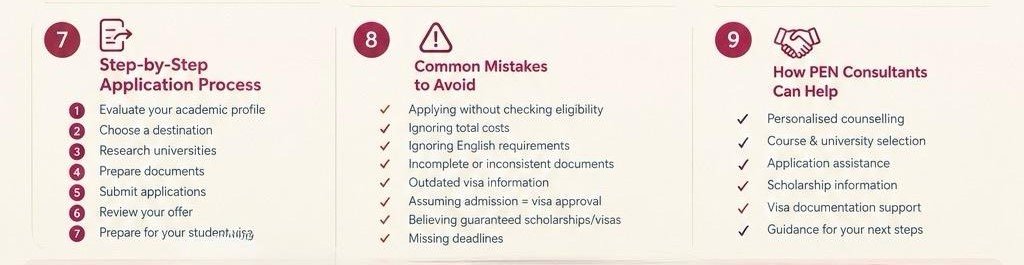
7. Step-by-Step Application Process
- Evaluate your academic profile. Review your subjects, grades, interests, and eligibility.
- Choose a destination. Compare countries according to your budget and academic goals.
- Research universities. Confirm entry requirements and whether you need a foundation programme.
- Prepare documents. Organise certificates, transcripts, passport details, and test results.
- Submit applications. Follow the institution’s application process and deadlines.
- Review your offer. Understand the conditions, tuition fees, and payment deadlines.
- Prepare for your student visa. Follow the current official immigration guidance for your chosen country.
For the 2027 intake, start researching early. Allow enough time for document preparation, university decisions, financial arrangements, and visa processing.
8. Common Mistakes to Avoid
Pakistani students should avoid these common application mistakes:
- Applying without checking academic eligibility.
- Choosing a university without calculating total costs.
- Ignoring English-language requirements.
- Submitting incomplete or inconsistent documents.
- Relying on outdated visa information.
- Assuming admission guarantees visa approval.
- Believing promises of guaranteed scholarships or visas.
- Missing application deadlines.
Careful research and realistic planning can help you make better decisions.
9. How PEN Consultants Can Help
PEN Consultants supports Pakistani students who want to explore international education opportunities and understand the application process. Our services can include:
- Personalised counselling based on your academic profile.
- Course and university selection guidance.
- University application assistance.
- Scholarship information and guidance.
- Visa documentation support.
- Guidance on preparing for the next stage of your education.
Every student’s circumstances are different. Your study plan should reflect your academic background, financial situation, and chosen destination.
Conclusion
Studying abroad after Intermediate in Pakistan can open up valuable educational opportunities. Whether you have completed FSc, FA, ICS, or I. Com, you may be able to pursue a bachelor’s degree through direct admission, a foundation programme, or another recognised pathway.
The key is to research universities carefully, understand admission requirements, plan your finances, and prepare your documents before applying.
Ready to start your study abroad journey?
Contact PEN Consultants to explore suitable destinations, review your academic profile, and plan your next steps towards international education.
PEN Consultants — A Gateway to Your Bright Future!